Shoulder pain can make even simple activities uncomfortable. Reaching into a cupboard, putting on a jacket, lifting weights, or sleeping on your side may suddenly become difficult. For some people, the discomfort develops gradually. For others, severe shoulder pain appears seemingly overnight, without an obvious injury.
One possible cause is calcific tendonitis of the shoulder, a condition involving calcium deposits within the rotator cuff tendons.
At Reform Health + Wellness in Red Deer, our chiropractors assess and manage shoulder conditions using individualized, evidence-informed care. Depending on your presentation, treatment may include radial shockwave therapy, dry needling or intramuscular stimulation (IMS), manual therapy, and targeted rehabilitation exercises.
Understanding what these treatments can—and cannot—do is an important part of choosing the right approach.
What Is Calcific Tendonitis of the Shoulder?
Calcific tendonitis, also called calcific rotator cuff tendinopathy, occurs when calcium hydroxyapatite crystals accumulate within a rotator cuff tendon.
The rotator cuff consists of four muscles and their tendons that help stabilize and move the shoulder. Calcific deposits most commonly affect the supraspinatus tendon, which plays an important role in lifting the arm.
Although the exact cause is not fully understood, researchers believe calcific tendinopathy involves a biological process in which calcium deposits form, remain relatively stable, and may eventually be reabsorbed by the body.
The condition is commonly described in three stages:
-
Pre-calcific stage: Changes occur within the tendon before calcium deposits develop.
-
Calcific stage: Calcium accumulates and may remain relatively quiet before entering a resorptive phase, when the body begins breaking down the deposit.
-
Post-calcific stage: The tendon undergoes repair and remodelling as calcium is reabsorbed.
Interestingly, the resorptive phase can be particularly painful because of the inflammatory response surrounding the calcium deposit. [1]
Not every calcium deposit causes symptoms, and the size of a deposit does not always correspond with the amount of pain someone experiences.
Common Signs and Symptoms of Calcific Shoulder Tendonitis
Symptoms vary depending on the location of the deposit, the stage of the condition, and whether surrounding tissues are irritated.
Common complaints include:
-
Pain along the front or outside of the shoulder.
-
Discomfort when reaching overhead or behind the back.
-
Pain when lifting weights, carrying objects, or performing repetitive movements.
-
Difficulty sleeping on the affected shoulder.
-
Reduced shoulder range of motion.
-
Weakness or difficulty using the arm because of pain.
-
Sudden, intense shoulder pain during an inflammatory episode.
Some patients experience persistent symptoms over several months, while others develop a much more acute and painful presentation.
These symptoms are not unique to calcific tendonitis, which is why an accurate assessment matters.
How Is Calcific Tendonitis Diagnosed?
At Reform Health + Wellness, a chiropractic shoulder assessment begins with understanding your symptoms, medical history, activity levels, and functional limitations.
Your chiropractor may assess:
-
Active and passive shoulder range of motion.
-
Rotator cuff strength and symptom response to resistance.
-
Shoulder blade movement and upper-back mobility.
-
Tenderness and sensitivity around the shoulder.
-
Neck and neurological findings when relevant.
-
Activities that reproduce or relieve your symptoms.
Several conditions can resemble calcific tendonitis, including non-calcific rotator cuff tendinopathy, rotator cuff tears, frozen shoulder, bursitis, arthritis, and pain referred from the cervical spine.
Diagnostic imaging can help confirm the presence of calcium deposits.
An X-ray can often identify calcification within the rotator cuff, while diagnostic ultrasound can provide additional information about the deposit and surrounding soft tissues.
Imaging is not necessary for every patient with shoulder pain. However, it may be appropriate when calcific tendonitis is suspected, symptoms are persistent, or the diagnosis remains uncertain. [1,2]
How Can Shockwave Therapy Help Calcific Tendonitis?
One non-surgical treatment option for calcific shoulder tendonitis is extracorporeal shockwave therapy (ESWT).
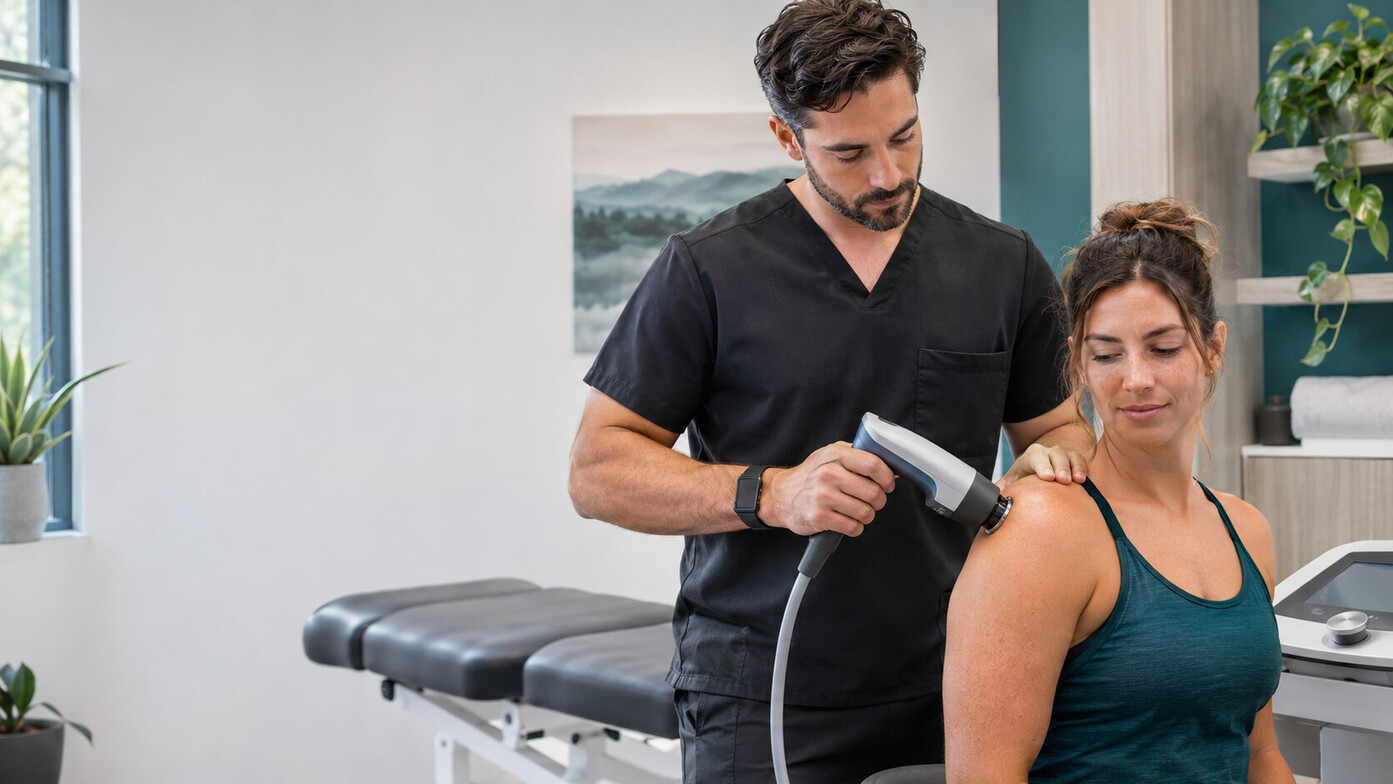
Shockwave therapy delivers controlled acoustic pressure pulses into the targeted tissues through a handheld applicator.
These mechanical pulses may influence local pain signalling and biological responses within the tendon and surrounding tissues. Some studies have also reported reductions in calcium deposit size following treatment, although the precise mechanisms and consistency of these changes remain uncertain.
Radial vs. Focused Shockwave Therapy
Not all shockwave machines deliver energy in the same way.
Radial shockwave therapy delivers pressure pulses that spread outward from the applicator, with the greatest pressure near the treatment surface.
Focused shockwave therapy concentrates energy within a more defined region at a selected tissue depth.
Both technologies have been investigated for calcific rotator cuff tendinopathy, but their treatment characteristics and research findings are not interchangeable.
At Reform Health + Wellness, we use radial shockwave therapy as a potential component of conservative shoulder care.
What Does the Research Say?
Research on shockwave therapy for calcific tendonitis is encouraging, but important limitations remain.
A 2024 systematic review by Brindisino and colleagues evaluated 21 randomized controlled trials. The researchers reported improvements in pain and shoulder function with shockwave therapy compared with sham treatment at certain follow-up intervals. Higher-energy treatments generally produced better results than lower-energy treatments in the comparisons studied. [3]
A randomized clinical trial by Cacchio and colleagues specifically investigated radial shockwave therapy in patients with calcific shoulder tendonitis and reported improvements in pain, function, and radiographic calcification findings. [4]
More recently, a 2025 network meta-analysis found favourable pain outcomes for radial shockwave therapy combined with rehabilitation. However, treatment rankings from indirect comparisons do not establish that one approach is consistently superior for every patient. [5]
The 2025 rotator cuff clinical practice guideline also supports considering shockwave therapy for calcific rotator cuff tendinopathy, while distinguishing it from non-calcific tendon conditions. [2]
The takeaway: Shockwave therapy may help reduce shoulder pain and improve function in appropriately selected patients. Calcium deposits may also decrease in size over time, but treatment does not guarantee that they will break apart, disappear, or resolve completely.
For more information about this treatment, visit our Shockwave Therapy service page.
What Role Does Dry Needling and IMS Play?
While shockwave therapy may be used to address calcific tendon-related symptoms, dry needling and intramuscular stimulation (IMS) may be considered for muscular pain and sensitivity that accompany shoulder conditions.
When a shoulder has been painful for an extended period, patients may develop increased muscle guarding, tender trigger points, and difficulty moving comfortably.
Muscles that may contribute to these symptoms include the infraspinatus, upper trapezius, deltoid, and muscles surrounding the shoulder blade.
Dry needling involves inserting thin, sterile needles into selected muscles or areas of myofascial sensitivity. IMS is a related needling approach used to address neuromuscular pain and muscle dysfunction.
Can Dry Needling Improve Shoulder Pain?
A randomized clinical trial published online in 2025 examined dry needling of rotator cuff trigger points in people with chronic rotator cuff-related shoulder pain. The study reported short-term improvements in pain and several functional measures compared with sham needling. [6]
However, the study was relatively small, had limited follow-up, and did not specifically examine patients with calcific tendonitis.
The broader evidence remains insufficient to conclude that dry needling is an effective treatment for calcific rotator cuff tendinopathy itself.
Importantly, conventional dry needling and IMS do not physically remove or dissolve calcium deposits.
They should also not be confused with ultrasound-guided calcific needling or lavage, commonly called barbotage, in which a clinician uses imaging guidance to puncture or flush a calcium deposit.
At Reform, IMS or dry needling may be considered when muscular symptoms are contributing to discomfort or limiting participation in rehabilitation.
Learn more about our Dry Needling and IMS treatments in Red Deer.
Why Combine Shockwave Therapy, IMS and Rehabilitation?
Calcific tendonitis can involve more than the calcium deposit itself.
A person with persistent shoulder symptoms may also experience reduced rotator cuff strength, limited movement, muscular sensitivity, and difficulty tolerating everyday activities.
For this reason, an individualized plan may address several contributors:
1. Shockwave therapy: May be considered for calcific tendon-related pain and function.
2. Dry needling or IMS: May help manage associated muscular symptoms in selected patients.
3. Chiropractic manual therapy: Joint mobilization, manipulation when appropriate, or soft tissue techniques may help address accompanying movement restrictions.
4. Rehabilitation exercises: Progressive mobility, rotator cuff strengthening, and shoulder blade exercises help rebuild movement capacity and tolerance to activity.
Rehabilitation is an important foundation of conservative rotator cuff care. The 2025 clinical practice guideline emphasizes active treatment and exercise-based rehabilitation, with manual therapy considered as an adjunct when appropriate. [2]
Although combining treatments may be clinically reasonable, there is not sufficient direct evidence to claim that radial shockwave therapy plus IMS is superior to either treatment alone for calcific tendonitis.
The purpose of combining treatments is to address the individual patient's symptoms, impairments, and functional goals—not simply to provide more interventions.
What to Expect During Treatment at Reform Health + Wellness
Your treatment begins with an assessment, rather than assuming that every painful shoulder requires shockwave therapy or dry needling.
Our chiropractors—Dr. Seth Means, Dr. Courtney Means, and Dr. Codi Loran—consider your examination findings, previous imaging, medical history, and treatment preferences when discussing appropriate options.
When shockwave therapy is indicated, a handheld applicator delivers repeated pressure pulses to the treatment area.
Patients commonly describe the sensation as rapid tapping or pulsing. Treatment intensity may be adjusted based on tolerance, and temporary soreness, redness, or bruising can occur afterward.
If dry needling or IMS is appropriate, sterile needles are inserted into selected muscles. Patients may experience a brief twitch, aching sensation, or temporary post-treatment soreness.
Your chiropractor will also screen for relevant precautions, including bleeding risks, medications, and other health considerations. Needling carries a small risk of infection, bleeding, and, when performed near the chest or upper shoulder, pneumothorax.
Not every patient is a suitable candidate for either treatment.
Throughout your care, we reassess pain, shoulder movement, strength, sleep, and function. If progress is limited or your presentation changes, we review the plan and consider whether further imaging or referral is warranted.
Other Treatment Options for Calcific Tendonitis
Many cases can be managed without surgery, and some calcium deposits gradually resolve naturally. [1]
Depending on symptom severity, duration, and response to treatment, other approaches may include activity modification, progressive exercise, and appropriate pain-relieving or anti-inflammatory medication under medical guidance.
For selected patients with persistent symptoms, a physician or specialist may consider an injection, ultrasound-guided calcific lavage, or a surgical consultation.
It is worth recognizing that evidence for these procedures is mixed. For example, a 2023 randomized, sham-controlled trial published in The BMJ found that ultrasound-guided lavage with corticosteroid injection did not provide superior outcomes to sham treatment at four months or two years. [7]
Treatment decisions should therefore consider the available research, the individual's circumstances, and their preferences.
Frequently Asked Questions About Calcific Tendonitis
Can shockwave therapy break down calcium deposits?
Some clinical studies have reported reductions or disappearance of calcium deposits after shockwave therapy. However, the process is not fully understood, and these outcomes cannot be guaranteed. Pain and function may improve even when imaging findings do not change substantially.
Is shockwave therapy painful?
Patients typically feel a rapid tapping or pulsing sensation that can be uncomfortable over sensitive tissue. Treatment intensity can often be adjusted, and temporary soreness afterward is possible.
Does dry needling remove calcium deposits?
No. Conventional dry needling and IMS target muscular or neuromuscular symptoms, not the calcium deposit itself. Ultrasound-guided calcific needling or lavage is a different medical procedure.
How many shockwave treatments might I need?
There is no universally established treatment schedule for calcific tendonitis. Research studies use different treatment protocols, and appropriate care depends on your diagnosis, response, and clinical circumstances. Your chiropractor will discuss a plan and reassess whether continuing treatment is worthwhile.
Can calcific tendonitis resolve without surgery?
Yes. Calcium deposits can be reabsorbed through the body's natural processes, and many patients improve with conservative management. Persistent or severe symptoms may require additional evaluation.
Should I get an X-ray before starting treatment?
Not everyone with shoulder pain requires immediate imaging. However, an X-ray is often useful when calcific tendonitis is suspected because it can identify calcium deposits. Your chiropractor can help determine whether imaging is appropriate based on your history and examination.
Calcific Tendonitis Shoulder Treatment in Red Deer
Persistent shoulder pain can affect your sleep, work, exercise, and everyday quality of life. Fortunately, surgery is not the only option for managing calcific rotator cuff tendinopathy.
At Reform Health + Wellness, our chiropractors take an individualized approach to shoulder pain, combining assessment, patient education, rehabilitation, and selected treatments such as radial shockwave therapy and IMS when appropriate.
Whether you have already been diagnosed with calcific tendonitis or are looking for answers about ongoing shoulder pain, our team can help you understand your options.
Ready to take the next step?
Book a chiropractic or shockwave assessment at Reform Health + Wellness in East Hill Shopping Centre, Red Deer.
Move Better. Live Better.
Scientific References
-
Saran S, Babhulkar JA, Gupta H, Chari B. Imaging of calcific tendinopathy: natural history, migration patterns, pitfalls, and management: a review. British Journal of Radiology. 2024;97(1158):1099–1111. https://doi.org/10.1093/bjr/tqae039
-
Desmeules F, Roy JS, Lafrance S, et al. Rotator cuff tendinopathy diagnosis, nonsurgical medical care, and rehabilitation: a clinical practice guideline. Journal of Orthopaedic & Sports Physical Therapy. 2025;55(4):235–274. https://doi.org/10.2519/jospt.2025.13182
-
Brindisino F, Marruganti S, Lorusso D, Cavaggion C, Ristori D. The effectiveness of extracorporeal shock wave therapy for rotator cuff calcific tendinopathy: a systematic review with meta-analysis. Physiotherapy Research International. 2024;29(3). https://doi.org/10.1002/pri.2106
-
Cacchio A, Paoloni M, Barile A, et al. Effectiveness of radial shock-wave therapy for calcific tendinitis of the shoulder: single-blind, randomized clinical study. Physical Therapy. 2006;86(5):672–682. https://doi.org/10.1093/ptj/86.5.672
-
Yao Y, Yang G, Jiang S, et al. Treatments for rotator cuff calcific tendinitis: a systematic review and network meta-analysis of randomized-controlled trials. EFORT Open Reviews. 2025;10(7):520–533. https://doi.org/10.1530/EOR-2024-0078
-
Ghasemi S, Abbasi L, Meftahi N, Amiri M. The effect of rotator cuff trigger points dry needling on the stability and function of the upper limb in people with shoulder pain: randomized clinical trial study. Journal of Hand Therapy. 2026;39(1):1–9. Published online June 18, 2025. https://doi.org/10.1016/j.jht.2025.04.005
-
Moosmayer S, Ekeberg OM, Björnsson Hallgren H, et al. Ultrasound guided lavage with corticosteroid injection versus sham lavage with and without corticosteroid injection for calcific tendinopathy of shoulder: randomised double blinded multi-arm study. BMJ. 2023;383. https://doi.org/10.1136/bmj-2023-076447
This article is intended for general educational purposes and does not replace individualized medical assessment or advice. Treatment suitability and outcomes vary between patients.
Clinically Reviewed by Seth Means, DC on Nov 6, 2026